X-Ray Machine Accessories: Essential Equipment for Hospitals, Clinics & Diagnostic Centres
Introductions
Modern medical imaging depends on more than just the X-Ray machine. Hospitals, diagnostic centres, radiology departments, and healthcare facilities also require suitable accessories to support equipment positioning, daily operations, and radiation protection practices.
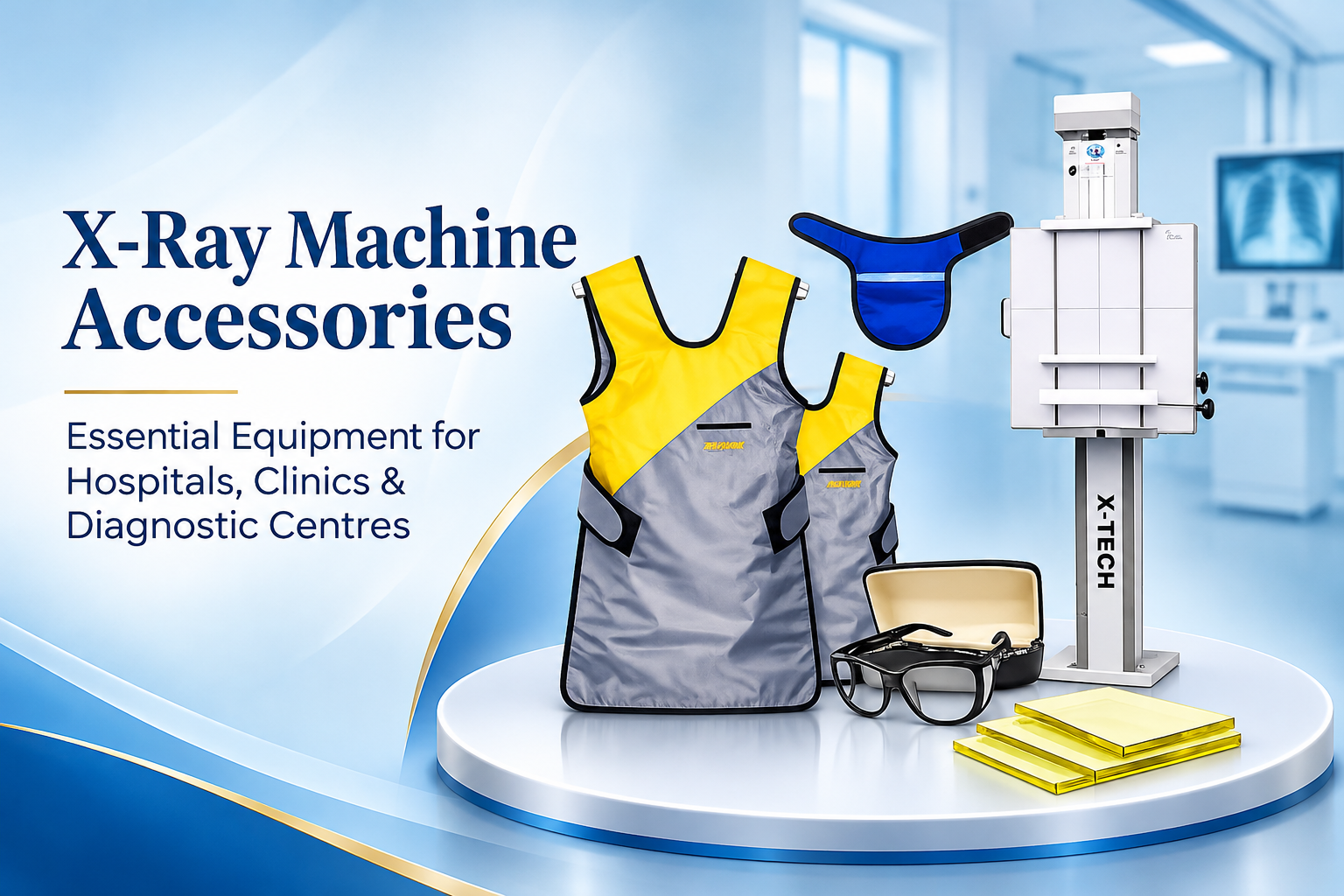
Choosing the right X-Ray machine accessories is an important part of planning a functional and appropriately equipped radiology department. Accessories such as lead aprons, thyroid shields, lead goggles, lead glass, and vertical Bucky stands serve different purposes within medical imaging environments.
Whether you are establishing a new diagnostic centre, upgrading an existing X-Ray room, or sourcing medical imaging equipment for a hospital, understanding these accessories can help you make informed purchasing decisions.
In this guide, we explain the main types of X-Ray machine accessories, their applications, and the important factors to consider when selecting them.
What Are X-Ray Machine Accessories?
X-Ray machine accessories are supporting products and components used in radiology departments alongside medical imaging equipment. Depending on their design, they may assist with patient positioning, equipment setup, radiation protection, or the operation of an X-Ray room.
These accessories are available in different configurations to suit conventional radiography systems, digital X-Ray machines, and other medical imaging installations.
The required accessories depend on the type of imaging equipment, room layout, clinical applications, and applicable radiation safety requirements.
For hospitals and diagnostic centres, purchasing compatible, properly specified accessories is essential for maintaining an organised and functional imaging environment.
7 Essential X-Ray Machine Accessories for Medical Facilities
1. Lead Apron for X-Ray Protection
A lead apron is a protective garment designed to reduce exposure to X-Rays in situations where its use is appropriate under the facility’s radiation protection protocol.
Lead aprons are commonly associated with radiation protection arrangements in medical imaging environments. Their design, protective rating, coverage, and fit should be appropriate for the intended application.
Important considerations when selecting a lead apron:
Appropriate lead equivalence or specified attenuation rating.
Suitable size, fit, and coverage.
Comfortable design for the intended duration of use.
Durable outer material and secure fastenings.
Inspection and storage requirements.
Lead aprons should be inspected periodically for damage according to the manufacturer’s instructions and the facility’s radiation safety procedures.
They should not be treated as a substitute for proper room shielding, distance, exposure controls, or other required radiation protection measures.
2. Thyroid Shield for Radiology
The thyroid is a radiation-sensitive organ, and a thyroid shield is designed to provide protective coverage around the neck.
Thyroid shields may be used in selected radiology applications where protective garments are indicated by the applicable protocol.
When choosing a thyroid shield, healthcare facilities should consider its protective rating, fit, fastening system, material quality, and compatibility with other protective garments.
Proper storage and regular inspection can help maintain the accessory in usable condition.
The need for thyroid protection depends on the specific imaging procedure and radiation safety guidance. It should be determined in accordance with the facility’s established protocols.
3. Lead Goggles for Radiation Protection
Lead goggles are specialised protective eyewear designed to reduce radiation exposure to the eyes in appropriate occupational settings.
They may be relevant in selected procedures where personnel are required to remain near the source of scattered radiation.
Before purchasing lead goggles, consider:
The specified radiation attenuation or lead equivalence.
Coverage around the eyes and sides of the face.
Comfort and fit for the intended user.
Optical clarity and visibility.
Compatibility with prescription eyewear, if required.
Protective eyewear should be selected according to the expected exposure conditions and the facility’s radiation protection assessment.
4. Lead Glass for X-Ray Rooms
Lead glass is a specialised radiation-shielding material used in suitable viewing windows and observation panels in X-Ray installations.
It can allow staff to observe activities in the imaging room while maintaining the required shielding when correctly specified and installed as part of the room’s protective design.
Selecting lead glass requires careful attention to:
Required shielding performance.
Glass thickness and specified lead equivalence.
Window dimensions and installation design.
Compatibility with the room’s shielding materials.
Applicable radiation safety requirements.
Important: Lead glass should not be selected on appearance or thickness alone. A qualified professional should determine the appropriate shielding specification based on the installation and applicable requirements.
5. Vertical Bucky Stand
A vertical Bucky stand is an equipment component used to support appropriate patient positioning during selected upright radiographic examinations.
Depending on its design and configuration, it may incorporate a receptor holder or grid arrangement for compatible imaging systems.
Vertical Bucky stands are commonly considered when planning a fixed X-Ray room where upright examinations are part of the clinical workflow.
Before purchasing a vertical Bucky stand, evaluate:
Compatibility with the X-Ray system and image receptor.
Available positioning and adjustment options.
Installation dimensions and room space.
Mechanical stability and construction.
Ease of cleaning and routine maintenance.
The correct configuration depends on the complete imaging system and the intended examinations.
6. X-Ray Tube and Related Components
The X-Ray tube is a key component of the imaging system that generates X-Rays. Related components may include tube supports, collimators, cables, and other system-specific parts.
These are not interchangeable accessories. Their suitability depends on the equipment model, electrical specifications, mechanical design, and manufacturer requirements.
When sourcing replacement components, healthcare facilities should verify compatibility with the existing machine and obtain installation assistance from appropriately qualified technical personnel.
Using an incompatible component can affect system operation and may introduce electrical, mechanical, or radiation safety risks.
7. Other Radiology Room Accessories
Depending on the installation, a radiology department may also require patient positioning aids, equipment supports, protective barriers, warning signs, and other components specified in its room design.
The selection should be based on the intended examinations, equipment configuration, staff workflow, and applicable radiation safety requirements.
An organised procurement checklist can help hospitals identify the products needed before installing or upgrading an X-Ray room.
Why Is Radiation Protection Equipment Important in X-Ray Departments?
Radiation protection is an essential part of medical imaging operations. Appropriate protective equipment can contribute to a broader radiation safety programme when selected and used correctly.
A well-planned programme generally considers several factors.
Protection According to the Application
Different procedures create different exposure conditions. Protective equipment should therefore be selected according to the clinical application, expected exposure, and relevant radiation protection protocol.
Proper Room Shielding
Structural shielding is a separate and important consideration when planning an X-Ray installation. Materials such as appropriately specified lead glass and other shielding components may be incorporated into the room design.
Room shielding should be determined by qualified professionals in accordance with applicable regulatory requirements.
Equipment Inspection and Maintenance
Protective garments and other accessories should be inspected according to the manufacturer’s instructions and the facility’s established procedures.
Damaged or unsuitable equipment should be assessed and replaced when necessary.
Staff Training and Safe Working Practices
Staff should understand how to use protective accessories, follow the facility’s radiation protection procedures, and comply with the relevant operational requirements.
Protective garments alone cannot guarantee safety. Appropriate equipment settings, shielding, distance, exposure control, and procedural practices remain important.
How to Choose the Right X-Ray Machine Accessories?
Selecting X-Ray machine accessories involves more than comparing prices. Hospitals and diagnostic centres should consider the following factors before placing an order.
1. Identify Your Equipment Requirements
Make a list of the existing X-Ray machine models, room configuration, intended examinations, and accessories already available.
This helps identify the products required for a new installation or equipment upgrade.
2. Check Specifications and Compatibility
Review the technical specifications, dimensions, protective ratings, and compatibility requirements of each accessory.
For components that connect directly to an X-Ray system, confirm the exact model and manufacturer specifications before purchasing.
3. Evaluate Material Quality and Durability
Protective garments and mechanical accessories should be suitable for their intended use and maintained according to the manufacturer’s instructions.
Evaluate construction quality, fastening systems, mechanical stability, and availability of replacement parts where applicable.
4. Consider Radiation Safety Requirements
Radiation protection products and room shielding materials should be selected according to the relevant safety assessment and applicable regulatory requirements.
For installations in India, healthcare facilities should consult the applicable Atomic Energy Regulatory Board (AERB) requirements and qualified radiation safety professionals.
5. Review Installation and After-Sales Support
For components that require installation or technical integration, verify the availability of appropriate technical assistance.
Clear documentation, maintenance guidance, and access to compatible replacement parts can also support long-term equipment management.
6. Compare Total Ownership Costs
The purchase price is only one part of the overall cost. Consider expected service life, inspection needs, maintenance, replacement requirements, and compatibility with the existing imaging system.
This approach can help healthcare facilities plan their procurement more effectively.
X-Ray Machine Accessories for Hospitals and Diagnostic Centres
Different healthcare facilities may require different accessory combinations.
Hospitals: May need a range of protective garments, room shielding components, equipment supports, and system-specific accessories across their radiology departments.
Diagnostic centres: May prioritise accessories compatible with their fixed or digital radiography installations, together with the protective equipment specified for their operations.
Clinics and smaller healthcare facilities: Should identify the accessories required for their particular imaging system, installation layout, and clinical applications.
New radiology installations: Should plan accessory procurement alongside the machine, room layout, electrical installation, shielding design, and relevant regulatory requirements.
The final selection should always be based on the equipment specifications and the needs of the healthcare facility.
Why Choose X-Tech Medical Systems for X-Ray Machine Accessories?
X-Tech Medical Systems Pvt. Ltd. is a medical imaging equipment manufacturer based in West Bengal, India. Its product portfolio includes X-Ray machines, C-Arm systems, Digital Radiography solutions, and X-Ray machine accessories.
The company’s listed accessory range includes products such as lead aprons, thyroid guards, lead goggles, lead glass, and vertical Bucky stands.
For hospitals, clinics, and diagnostic centres planning a new radiology installation or upgrading an existing setup, X-Tech Medical Systems provides an option to explore medical imaging equipment and associated accessories through one supplier.
When enquiring about a product, buyers should confirm the available model, specifications, protective rating where applicable, compatibility, delivery arrangements, and installation requirements.
If you are looking for an X-Ray Machine Accessories Manufacturer in Kolkata or an X-Ray Accessories Supplier in India, contact X-Tech Medical Systems Pvt. Ltd. to discuss your requirements and request product details.
Conclusion
X-Ray machine accessories play an important supporting role in medical imaging environments. From lead aprons and thyroid shields to lead glass, vertical Bucky stands, and system-specific components, each product serves a particular purpose.
The right selection depends on the equipment configuration, intended application, room layout, compatibility, and applicable radiation safety requirements.
Hospitals and diagnostic centres should prioritise appropriate specifications, product quality, maintenance guidance, and technical support rather than choosing accessories based on price alone.
X-Tech Medical Systems Pvt. Ltd. offers a range of medical imaging equipment and accessories for healthcare facilities in India.
Looking for X-Ray machine accessories for your hospital or diagnostic centre?
Contact X-Tech Medical Systems Pvt. Ltd. to enquire about available accessories, confirm technical specifications, and request a quotation.
Website: https://xraymachines.in/
Phone: +91 9883349060
Email: info@xraymachines.in
Location: West Bengal, India
What People Mostly Asked?