
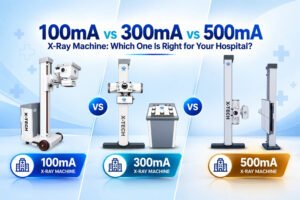
100mA vs 300mA vs 500mA X-Ray Machine: Which One Is Right for Your Hospital?
Choosing the right X-Ray machine is an important decision for hospitals, nursing homes and diagnostic centres.
X-Tech Medical Systems Pvt. Ltd.

Artificial Intelligence (AI) is rapidly changing the way medical imaging is performed, analyzed, and managed. In 2026, AI is no longer limited to research laboratories or technology demonstrations. AI-assisted radiology workflows are increasingly being used to support image analysis, prioritize critical cases, improve reporting efficiency, and assist healthcare professionals in managing growing imaging volumes.
Digital X-Ray systems are particularly well positioned for this transformation because they already produce digital images that can be integrated with advanced software, PACS, hospital information systems, and AI-based imaging solutions.
For hospitals, diagnostic centres, and radiology departments looking to upgrade their imaging infrastructure, understanding the role of AI in Digital X-Ray is becoming increasingly important.
AI in Digital X-Ray refers to the use of artificial intelligence and machine learning technologies to assist with the processing, analysis, prioritization, and interpretation of digital X-ray images.
Modern AI systems can analyze X-ray images and identify patterns that may require further clinical attention. Depending on the application, AI can assist with tasks such as:
Importantly, AI is designed to support healthcare professionals rather than replace the radiologist. Final clinical diagnosis and patient management remain the responsibility of qualified medical professionals.
Radiology departments are dealing with increasing imaging volumes while healthcare facilities continue to face workflow and staffing challenges. Industry forecasts for 2026 identify AI-based workflow integration as one of the major trends shaping radiology.
AI can help healthcare facilities manage this increasing workload by assisting with repetitive tasks and bringing potentially important cases to the attention of radiologists.
Recent research has also highlighted significant progress in AI-based chest radiography, including deep learning, transformer-based models, and multimodal approaches. At the same time, researchers continue to identify challenges involving bias, generalization, explainability, and clinical integration.
This means the future of AI in radiology is not simply about having an AI algorithm. The bigger focus is on integrating AI effectively into the complete clinical workflow.
A typical AI-assisted Digital X-Ray workflow can involve several stages:
The X-ray machine captures the patient’s image using a digital detector. Unlike conventional film-based systems, digital radiography produces an electronic image that can be processed and transferred electronically.
Advanced image-processing technologies can optimize the captured image for clinical review. Modern radiography technology is increasingly combining advanced detectors, AI-assisted processing, wireless connectivity, and dose optimization.
Depending on the AI application, software can analyze the image for specific patterns or findings. For example, chest X-ray AI solutions may assist in identifying abnormalities that require further review.
AI can help prioritize potentially urgent studies so that radiologists can review important cases more efficiently.
The radiologist reviews the original X-ray along with any AI-generated information and makes the final clinical assessment.
This human-AI workflow is becoming an important direction for modern radiology.
AI can automate or support certain repetitive image-analysis tasks, helping radiology departments manage high imaging volumes more efficiently.
AI-based systems can highlight patterns that may require closer attention. This can be particularly useful in high-volume screening and chest radiography workflows.
When a department receives a large number of X-ray studies, AI-based prioritization can help bring potentially critical cases to the radiologist’s attention sooner.
Digital X-Ray systems can integrate with PACS, hospital information systems, and other digital healthcare infrastructure, creating opportunities for AI-assisted workflows.
Digital images can be transmitted electronically, making them suitable for remote reporting and distributed radiology workflows. AI can potentially add another layer of assistance to these digital workflows.
Chest radiography is one of the most important areas for AI development because chest X-rays are widely used across hospitals, emergency departments, intensive care units, health screening programs, and diagnostic centres.
Recent research shows continued development of AI for chest radiography, including deep-learning and multimodal systems.
India is also seeing practical applications. For example, a 2026 Government of India best-practices compendium describes an AI-enabled chest X-ray screening initiative in Goa, where digital chest X-rays are analyzed to help identify high-risk cases and support referral for confirmatory diagnostics.
This demonstrates how AI-assisted X-ray workflows can move beyond experimentation and become part of broader screening and healthcare delivery systems.
One of the biggest misconceptions about AI in medical imaging is that artificial intelligence will completely replace radiologists.
That is not the current direction of responsible clinical AI adoption.
AI can assist with image analysis, prioritization, workflow automation, and decision support, but clinical interpretation requires medical expertise and patient context.
Recent radiology research emphasizes that AI can improve workflow and diagnostic support while the role of the radiologist remains essential.
The most practical model is therefore:
Digital X-Ray + AI Assistance + Radiologist Expertise = Smarter Radiology Workflow
Hospitals and diagnostic centres planning to invest in modern X-ray equipment should look beyond the basic generator specifications.
The system should provide high-quality digital images suitable for clinical diagnosis and future software integration.
The detector is an important component of a modern Digital Radiography system. Wireless and advanced flat-panel detector technologies can improve flexibility and workflow.
Radiation dose management should be an important consideration when selecting an X-ray system. Modern radiography development increasingly focuses on balancing image quality with dose optimization.
Consider whether the system can integrate effectively with existing PACS, RIS, hospital information systems, and digital reporting workflows.
For hospitals with ICUs, emergency departments, operating rooms, and bedside imaging requirements, mobile Digital X-Ray systems can provide important workflow advantages.
Healthcare facilities should consider whether their imaging infrastructure can support future AI-assisted applications and software integration.
Equipment availability is only one part of the investment. Installation, maintenance, technical support, training, and after-sales service are equally important considerations.
Mobile Digital X-Ray systems are particularly useful when patients cannot easily be transported to a radiology department.
These systems can bring imaging directly to:
In 2026, AI is also being integrated into mobile X-ray workflows. For example, new Indian solutions have demonstrated OEM-embedded AI capabilities for mobile DR systems, including automated triage and preliminary chest-X-ray findings.
This combination of mobile DR + wireless workflow + AI assistance represents an important direction for modern hospital imaging.
The next phase of radiology AI is expected to move beyond individual image-detection tools toward more integrated clinical workflows.
Some important developments include:
AI can assist radiologists by organizing findings and supporting preliminary report generation.
Newer systems are increasingly exploring combinations of medical images with clinical information and text rather than analyzing images in isolation.
AI may increasingly assist with patient prioritization, worklist management, quality control, and reporting workflows.
Mobile X-ray systems with integrated AI capabilities could become increasingly useful in ICUs, emergency departments, and bedside imaging environments.
As hospitals adopt PACS, RIS, teleradiology, and other digital platforms, AI can become another component of the connected radiology ecosystem.
For hospitals and diagnostic centres planning a new X-ray installation or upgrading an existing system, AI should be considered as part of the overall digital imaging ecosystem, rather than as the only reason to purchase equipment.
A good investment should combine:
The exact configuration should depend on patient volume, clinical applications, available space, budget, and the requirements of the radiology department.
There is no single X-Ray machine that is perfect for every healthcare facility.
The right choice depends on several factors, including:
For example, a diagnostic centre with a dedicated radiology room may consider a fixed Digital X-Ray or DR system, while a hospital requiring imaging flexibility may consider a mobile X-Ray solution. Facilities requiring image-guided procedures may need a C-Arm system.
Therefore, it is always recommended to discuss your requirements with an experienced medical imaging equipment manufacturer before finalizing a system.
AI is becoming an important part of the evolution of Digital X-Ray and modern radiology. From image analysis and workflow prioritization to reporting assistance and bedside imaging, artificial intelligence is creating new possibilities for hospitals and diagnostic centres.
However, the future is not about replacing radiologists. It is about combining advanced Digital X-Ray technology, AI-assisted tools, and clinical expertise to create faster, more connected, and efficient imaging workflows.
For healthcare facilities planning to invest in a new Digital X-Ray Machine, understanding both the hardware and the emerging AI ecosystem can help them make a more future-ready decision.
Looking for Digital X-Ray Machines, Mobile X-Ray Systems, C-Arm Systems or other radiology equipment? Explore the latest X-Ray solutions from X-Tech Medical Systems and choose a system according to your hospital or diagnostic centre’s requirements.
AI in Digital X-Ray uses artificial intelligence and machine learning to assist with image analysis, workflow prioritization, image processing, and other radiology tasks.
No. AI is primarily intended to support radiologists by assisting with image analysis and workflow. Final clinical interpretation remains the responsibility of qualified healthcare professionals.
AI-assisted X-Ray workflows can help with image analysis, case prioritization, workflow efficiency, reporting support, and high-volume imaging management.
AI capabilities can be integrated with digital radiography workflows through compatible software and imaging platforms. Availability and functionality depend on the specific equipment and software configuration.
Digital X-Ray produces electronic images that can be processed, stored, transferred, and integrated with digital healthcare systems, making them suitable for AI-based imaging workflows.
Choosing the right X-Ray machine is an important decision for hospitals, nursing homes and diagnostic centres.
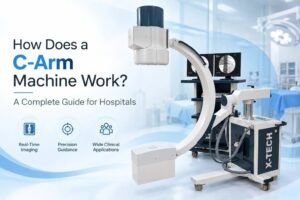
A C-Arm Machine is an important medical imaging system used in hospitals, surgical centres and other healthcare facilities where real-time X-Ray imaging is required during medical procedures.

If you are planning to purchase an X-ray machine for a hospital, diagnostic centre, nursing home, clinic or radiology department, one of the first questions you may have is: What is the cost of an X-ray machine in West Bengal, India?